What the reef is built from
The Norwegian island of Røst sits at the outer edge of the Lofoten archipelago, where the continental shelf drops sharply into the Norwegian Sea. In 2002, a survey vessel mapping the bottom at roughly 300 to 400 metres found something that rewrote the scale of cold-water coral in European waters: a reef complex stretching approximately 35 kilometres in length, built almost entirely by a single coral, Lophelia pertusa — now reclassified as Desmophyllum pertusum. The Røst Reef remains one of the largest known cold-water coral structures on Earth.
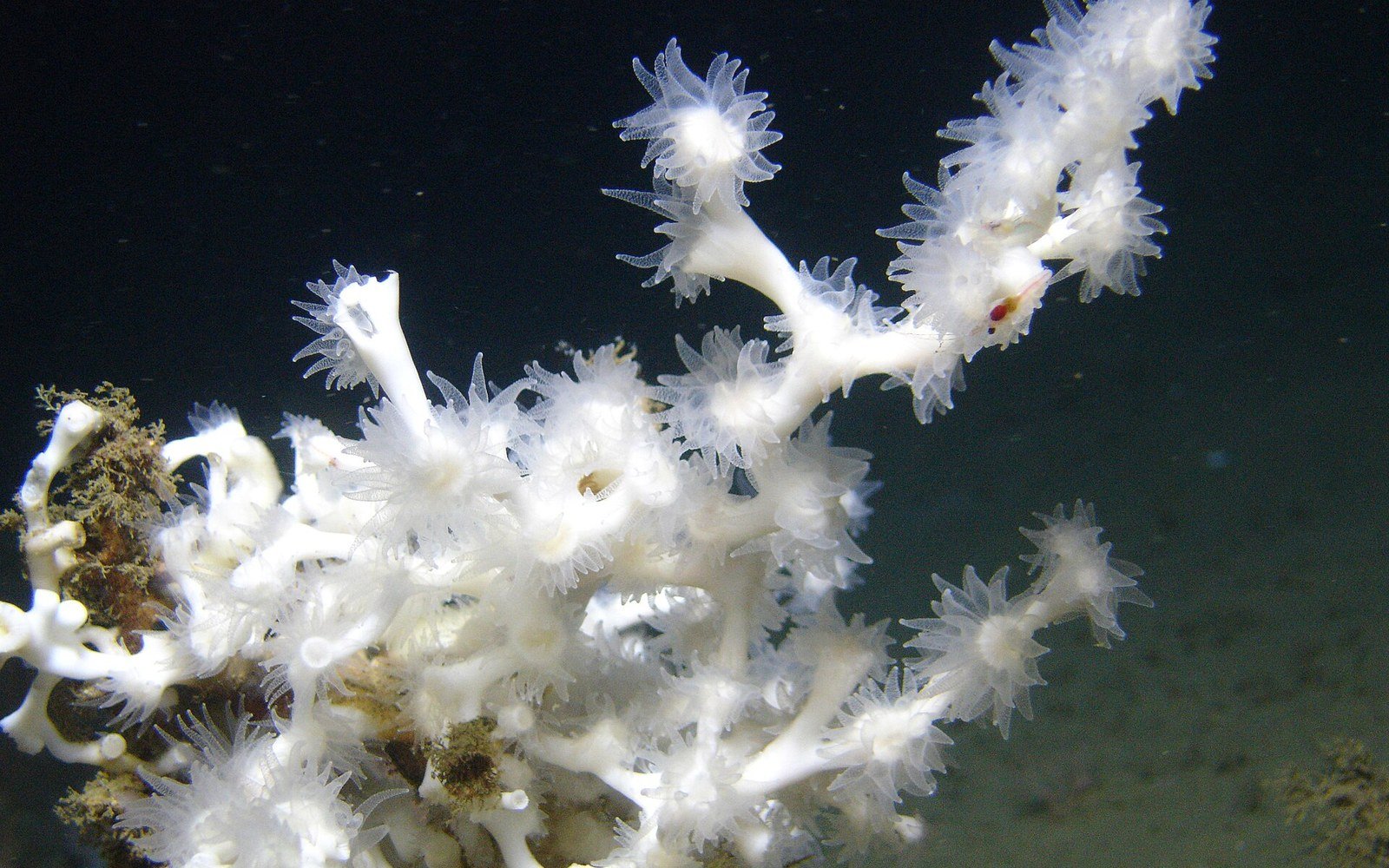
The mechanism here has nothing in common with tropical reef-building. Shallow tropical corals run on photosynthesis, hosting symbiotic algae called zooxanthellae that convert sunlight into carbon. At 300 metres depth, no usable light penetrates. Lophelia is entirely heterotrophic: it captures zooplankton and suspended organic particles directly from the water column, using nematocyst-armed tentacles to seize prey that drifts by on the current. The coral's calcium carbonate skeleton is secreted directly from seawater chemistry, requiring only adequate concentrations of aragonite — the specific polymorph of calcium carbonate from which Lophelia builds — and the cold, oxygen-rich Atlantic water that the Norwegian shelf provides in abundance.
Growth is slow by any measure. Individual Lophelia branches extend by roughly one centimetre per year. The reef at Røst is thought to have been building for around 8,000 years, which puts its origins in the early Holocene. The structure that accumulates is not a thin veneer: dead coral framework beneath living polyps builds up into mounds that can reach tens of metres in height, honeycombed with chambers that shelter fish, crustaceans and echinoderms in densities that contrast starkly with the bare sediment surrounding them.
Measuring structure in the dark
Surveying a reef at this depth requires equipment that surface-based transect work cannot provide. At Røst, mapping has combined multi-beam echo-sounding — which returns a detailed bathymetric surface — with remotely operated vehicle (ROV) video transects that document species composition and framework condition at the seafloor. Norwegian Institute of Marine Research scientists have used ROV surveys to establish the physical boundaries of the complex and to distinguish living reef edge from the rubble fields of dead framework that lie to the interior and downslope.
The critical measurement for the reef's structural health is aragonite saturation state, expressed as Ω_arag. Waters with values below 1.0 are undersaturated: calcium carbonate dissolves faster than organisms can deposit it, and framework accumulation stops. North Atlantic deep water currently sits comfortably above that threshold, which is why Lophelia thrives here and not at equivalent depths in parts of the Pacific where deep upwelling brings older, more carbon-dioxide-laden water toward the surface. The saturation boundary is a chemical line as sharp in its effects as any terrestrial habitat edge; it simply cannot be walked.
Alongside Lophelia, the Røst structure supports a suite of framework contributors: the sponge Geodia spp. adds siliceous mass, crinoids colonise elevated surfaces for access to current, and over 700 associated invertebrate and fish species have been catalogued across Norwegian cold-water coral sites in aggregate. The reef functions as habitat that is built, not found — the physical architecture created by the coral is itself the substrate on which everything else depends, which makes Lophelia an ecosystem engineer in the same structural sense as kelp or beaver, only operating where light has never reached.
What distinguishes the Røst Reef from surface-visible biogenic habitats is precisely its medium. The deep Norwegian shelf is cold, dark and hydrodynamically driven, and cold-water corals recorded in GBIF's occurrence database show that Lophelia's range follows current regime and water chemistry rather than latitude or temperature in any simple sense. Røst sits in the current, the chemistry is right, and 8,000 years of slow carbonate deposition have built a structure that ecologists measure in kilometres.